

Most “free zone company setup in UAE” delays are not caused by the free zone itself. They happen because founders apply before they have made a few critical structuring decisions, and before they have assembled a coherent KYC and banking narrative.
If your goal is a fast, bankable setup in 2026, preparation matters as much as the incorporation filing. Below is a practical, authority-agnostic guide to what to prepare before you start, so your chosen free zone can actually issue the licence without rework, and your bank application does not stall.
First, be clear on what you are setting up (because the paperwork depends on it)
Free zones are licensing authorities. They issue a trade licence for a specific activity (or set of activities), for a specific legal form, with a defined ownership and management profile. Your “prep list” depends on these variables.
Before collecting documents, write down these five inputs:
- Your business activity (what you do in plain English, and what you will invoice for)
- Where customers are located (UAE, outside UAE, or mixed)
- Ownership (individual shareholders, corporate shareholder(s), or a mix)
- People plan (how many visas you need in the first 12 months)
- Banking and payments (expected incoming/outgoing flows, currencies, counterparties)
If you have not decided these yet, start with Alldren’s broader formation guidance, then come back to this preparation checklist: Company formation in UAE free zone: step-by-step and How to setup a company in the UAE: start here.
What to prepare, in two buckets: decisions and documents
Think of free zone setup as two parallel workstreams:
-
Registry work (licence issuance), where the free zone is your gatekeeper.
-
Operational readiness (banking, tax, invoicing, contracts), where banks and the Federal Tax Authority become your gatekeepers.
This table summarises what you should have ready before submitting an application.
| Area | Prepare this before applying | Why it matters in practice |
|---|---|---|
| Licensing scope | Activity description, target markets, revenue model | Avoids “activity mismatch” queries and later re-licensing |
| Ownership | Shareholder and UBO structure, control narrative | Drives KYC level, approvals, and bank risk classification |
| Management | Who will be manager/director and signatory | Banks and free zones often require clear authority documents |
| Premises | Workspace plan that matches banking expectations | Office proof impacts bank onboarding and field-visit outcomes |
| Compliance | Accounting owner, tax posture, recordkeeping plan | Prevents post-licence non-compliance and rushed registrations |
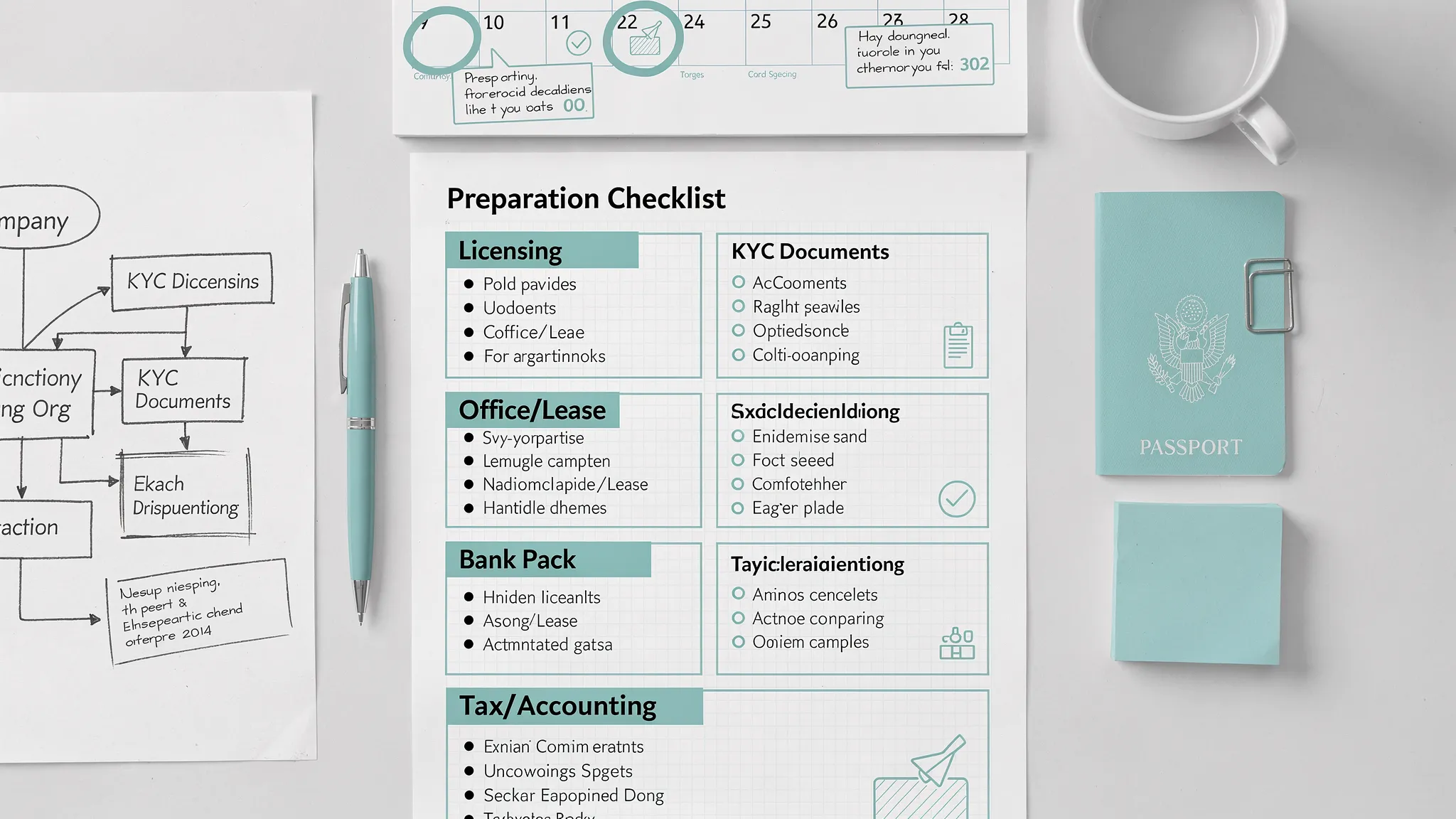
The KYC file: what every free zone and bank will ask you for
Exact requirements vary by authority and by your risk profile, but these items are consistently requested.
For individual shareholders (common baseline)
Prepare clean, high-resolution scans (and keep originals accessible):
- Passport (validity, signature page, and any relevant visa pages)
- UAE entry stamp page (if applicable)
- Proof of residential address (typically a recent utility bill or bank statement)
- Photo ID where relevant (some processes request a second ID)
- Basic CV or LinkedIn profile (to support background checks)
Practical tip: banks frequently cross-check spelling, address formatting, and dates across documents. Small inconsistencies create avoidable queries.
If there is a corporate shareholder (expect a heavier pack)
Corporate shareholders can be perfectly workable, but you should expect more diligence. Prepare:
- Certificate of Incorporation of the shareholder
- Register of shareholders/directors (or equivalent incumbency evidence)
- Constitutional documents (MOA/AOA or equivalent)
- Board resolution approving the UAE free zone investment and appointing a signatory
- Ownership chart showing the natural-person UBO(s)
If your group has multiple layers, assume your bank will want a clear “chain of ownership” to the natural persons and a rational commercial explanation.
UBO information (do not treat this as a formality)
The UAE’s beneficial ownership regime is “regulator-first”, meaning UBO details are filed with licensing authorities and accessible to competent authorities. The practical lesson is simple: you need a consistent, defensible UBO story from day one.
Prepare:
- Full legal names, nationalities, dates of birth, and ownership percentages
- Control explanation if ownership is indirect (for example, via a holding company)
- Supporting documents for the UBO individuals, not just the immediate shareholder
For a deeper compliance overview, see: The UAE’s UBO register: what is actually visible.
Business narrative: a one-page profile that prevents 80% of questions
In 2026, “we are a consultancy” is not a sufficient onboarding explanation for either a bank or a free zone compliance team. Write a one-page business profile and keep it updated.
Include:
- What you sell (services or products) and how you deliver
- Customer geographies and typical contract sizes
- Expected monthly transaction volumes and average ticket size
- Payment rails (SWIFT, card, payment processors, marketplaces)
- Key suppliers and expenses (software, subcontractors, logistics)
This becomes the backbone of your bank onboarding pack. If you want a banking-specific checklist, Alldren has a dedicated guide: Company bank account opening in UAE: approval checklist.
Premises and “substance”: prepare an office plan that matches banking reality
A free zone can issue a licence with a range of workspace solutions. Banks, however, increasingly assess whether your premises match the operational story.
What to prepare:
- Your intended workspace type (flexi desk, co-working, private office)
- Any lease or facility agreement you will sign
- If you will have staff, a plan for where they physically work
If your strategy is to open a Tier-1 local bank account, do not assume a generic address will be accepted. Banking standards in 2026 are increasingly sensitive to physical nexus and address clustering. For context, see: When a flexi-desk is not enough: UAE corporate banking address requirements in 2026.
Immigration readiness (if you need UAE residence visas)
Many founders start a free zone setup primarily to obtain residence. That is valid, but you still need to plan it like a compliance process.
Prepare:
- Who needs a visa (shareholder, manager, employees)
- Where you will complete medical and biometrics (timing and travel constraints)
- Whether dependents will be sponsored later
If your visa plan is central to the project, it should influence your free zone choice and facility package from the beginning. Related: UAE residency through business: options and steps.
Tax and accounting preparation (do this before your first invoice)
Free zone incorporation is not the finish line. In 2026, your tax posture is part of your bankability and audit readiness.
Corporate tax: decide your approach early
You do not need to be a tax expert, but you do need a plan:
- Who will own the accounting process (internal person or outsourced provider)
- What accounting standard you will follow (most businesses use IFRS-based financials)
- Whether you expect to qualify for any free zone specific treatment (this is fact-dependent and must align with real operations)
For a high-level reference, use the UAE Federal Tax Authority guidance pages, and Alldren’s practical overview: UAE tax in 2026: what businesses must know.
VAT: do not assume “export services” means “no VAT admin”
A common preparation gap is VAT. Even if you bill non-UAE clients, VAT registration can still be triggered depending on your taxable supplies and thresholds.
- Track expected revenue from day one
- Keep contracts and evidence of customer location
See FTA references at the UAE Federal Tax Authority and Alldren’s explanation: VAT and global services: why zero-rated exports still require registration.
E-invoicing and invoicing discipline
If your customers are corporate clients (especially in Europe, the UK, or larger groups), invoice quality affects payment speed and counterparty acceptance. Preparation here is mostly operational:
- Decide your invoicing tool early
- Ensure your invoices can display the correct legal name, licence details, and tax identifiers when applicable
- Keep a clean contract-to-invoice trail
This is also why many professionals move from personal invoicing to a company structure. If relevant: Why Western corporate clients now refuse to pay UAE freelancer personal invoices.
Banking prep: build a “bank-ready pack” before you apply
A frequent mistake is treating the bank account as a post-setup problem. In reality, your licence, office plan, ownership story, and expected flows should be designed with bank onboarding in mind.
Prepare these items in advance:
- Corporate structure chart (simple, readable)
- One-page business profile (as above)
- Draft client contract template or sample invoices (if you already have them)
- Evidence of source of funds and source of wealth where relevant (especially for larger initial deposits)
- A short “expected account activity” note (currencies, monthly volume, top counterparties)
If you want a full walkthrough, see: How to open a company bank account in UAE faster.
Authority and signing: avoid last-minute document scrambles
Even single-owner companies run into delays because nobody has clearly documented authority to sign.
Prepare to answer:
- Who will be the manager/director on the licence?
- Who will be the bank account signatory?
- If someone signs under POA, is that POA acceptable to the bank involved?
If you have multiple shareholders, align early on signing rules and reserved matters. Otherwise, you can end up with a licence that exists but cannot operate smoothly.
A pre-submission checklist you can use (quick scan)
Use this as a final readiness check before submitting your free zone application:
- Activity is defined in plain English (and is licensable)
- Trade name options are ready (with alternatives)
- Shareholder(s) and UBO(s) are mapped, with consistent spelling and percentages
- KYC scans are clear, current, and match across documents
- Office/workspace plan matches your banking ambition
- Visa requirements are counted and scheduled
- One-page business profile is drafted
- Bank-ready pack is assembled (even if you apply to banks later)
- Accounting owner is appointed, and recordkeeping starts immediately after licence issuance
If you want a broader planning view (timeline and common cost drivers), use: UAE free zone company registration: costs and timeline.
Common preparation mistakes (and how to avoid them)
Choosing a free zone before choosing an activity
A free zone is not just a price list. It is an activity framework. Start with what you do, then pick a jurisdiction that licences it cleanly.
Underestimating banking scrutiny
If your structure is hard to explain (or looks like it was built purely to “get a bank account”), onboarding becomes slow. Prepare your narrative and documents as if you will be questioned, because you will.
Treating bookkeeping as optional
Good accounting is not only about tax. It is how you answer bank questions, renew licences smoothly, and pass counterparty due diligence.
If you need ongoing governance and compliance support, see: Company secretarial services for UAE compliance.
Frequently Asked Questions
What documents are needed for free zone company setup in UAE? Most free zones require passports, proof of address, and basic background information for shareholders and UBOs. If a corporate shareholder is involved, you will also need incorporation documents, constitutional documents, and board resolutions, plus an ownership chart to the ultimate natural-person owners.
Do I need an office before I apply for a free zone licence? You typically need to select a workspace solution as part of the licence package. The bigger issue is whether the workspace you choose will satisfy your bank’s expectations for your activity and risk profile.
Should I open a bank account before or after the licence is issued? You usually apply after the licence is issued, but you should prepare the bank-ready pack before you incorporate. Your licensing choices (activity, office, management, ownership) directly affect onboarding outcomes.
Do free zone companies need to register for corporate tax and VAT? Corporate tax registration requirements depend on your facts and the applicable rules, and VAT registration depends on your taxable supplies and thresholds. You should plan both early and align your accounting and invoicing processes accordingly.
How long does a free zone company setup in UAE take if I am prepared? Timelines vary by free zone, activity, and shareholder profile. Preparation mainly reduces back-and-forth, avoids name and activity rework, and accelerates banking and immigration steps that often become the real bottlenecks.
Need your free zone setup to be bankable, not just incorporated?
Alldren helps founders and international clients structure and execute free zone company setup in UAE with a focus on bank readiness, compliance, and clean governance from day one, with transparent scope and direct access to senior experts.
If you want to sanity-check your activity, ownership/UBO profile, office plan, and banking pack before you file, explore Alldren’s services at alldren.com or start with their broader formation guidance: How to setup a company in the UAE: start here.


