

Setting up a UAE company is often described as a licensing exercise. For serious founders, that is the wrong starting point. A trade license is only one part of the system. The real objective is to create a company that can invoice, receive payments, obtain visas, satisfy bank compliance, meet tax obligations, and survive due diligence from investors, clients, and regulators.
For founders searching how to setup business in the UAE, the best approach is to work backward from operations. What will you sell? Who will pay you? Where will the team sit? Which bank will accept the profile? What records will you need when the Federal Tax Authority, a bank, or a large customer asks questions six months later?
This founder checklist gives you a practical sequence for making those decisions before you incorporate, not after problems appear.
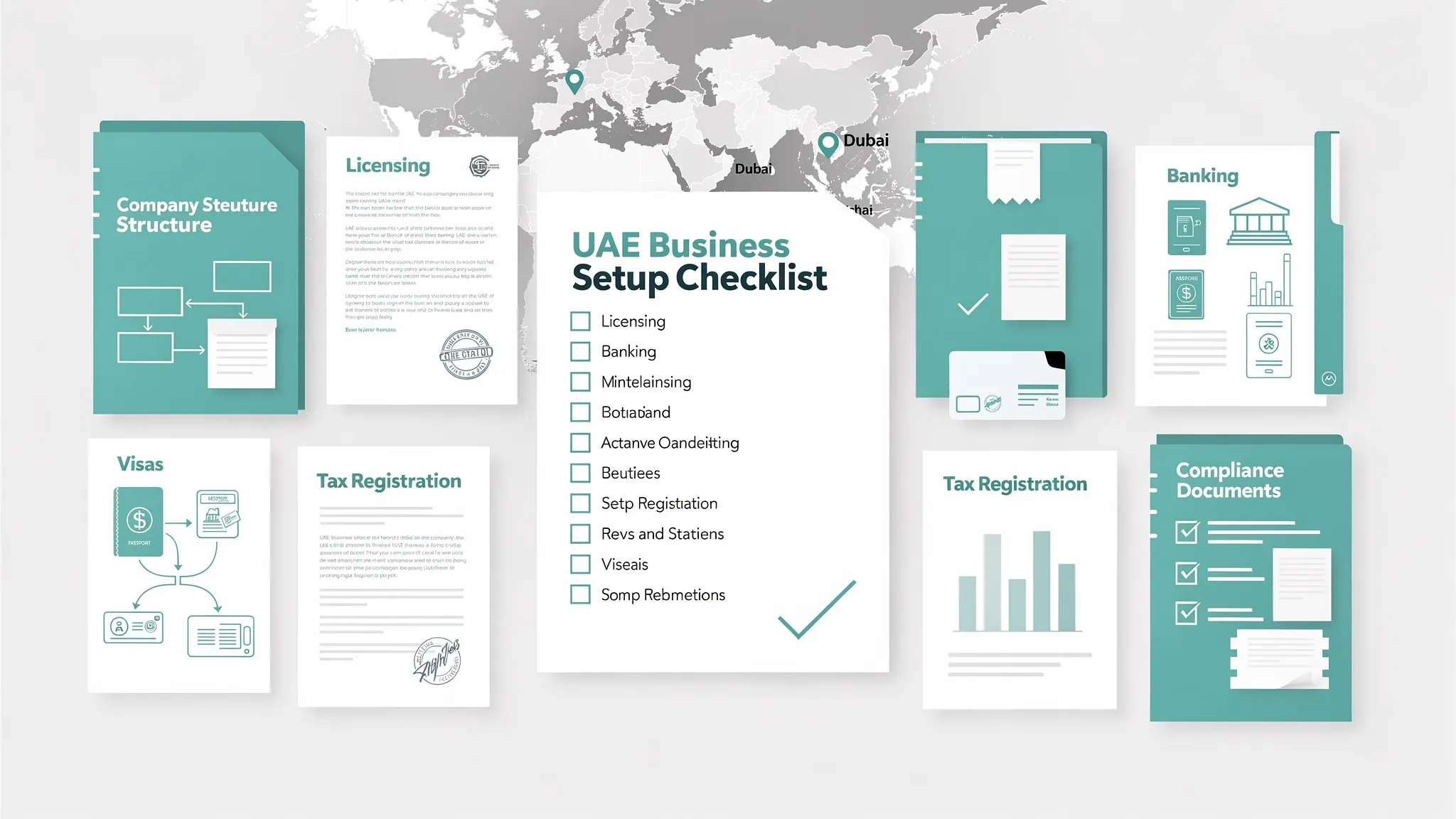
The founder checklist at a glance
A clean UAE setup is not about choosing the cheapest package. It is about aligning seven moving parts: activity, jurisdiction, ownership, premises, banking, visas, and compliance.
| Phase | Founder decision | Output you should have |
|---|---|---|
| Commercial design | What the company will sell, where revenue will come from, and who will pay | One-page business setup brief |
| Structure | Mainland, free zone, offshore, or a layered structure | Jurisdiction and legal form decision |
| Licensing | Activity codes, approvals, trade name, and premises | License application pathway |
| Banking | Bank fit, KYC, source of funds, expected transactions | Bank-ready onboarding pack |
| Immigration | Founder and employee visas, Emirates ID, establishment card | Visa and residency plan |
| Tax and accounting | Corporate Tax, VAT, bookkeeping, invoicing, records | Tax registration and compliance calendar |
| Governance | Shareholders, managers, signing powers, UBO records | Corporate records file and resolutions |
Use this table as a project plan. If any row is unresolved, pause before filing. Incorporation is much easier to adjust before a license is issued than after the company has contracts, bank applications, and tax records attached to it.
1. Start with the business model, not the company package
Before you compare free zones or ask for prices, write a short business model brief. It does not need to be long, but it must be specific enough for a licensing authority, bank, tax adviser, and future client to understand what the company actually does.
Your brief should answer:
- What services or products will the company provide?
- Will customers be in the UAE, overseas, or both?
- Will the company import goods, hold inventory, handle client funds, or operate online platforms?
- What are the expected monthly transaction volumes, currencies, and counterparties?
- Who are the shareholders, directors, managers, and bank signatories?
- Will the founders or employees need UAE residency visas?
- Are any activities regulated, such as financial services, virtual assets, real estate brokerage, recruitment, education, healthcare, or insurance?
This brief becomes the anchor for the whole setup. It helps avoid one of the most common founder mistakes: buying a license that looks correct on paper but does not match the company’s contracts, bank profile, or tax position.
If you are still clarifying the basics, Alldren’s guide on how to setup a company in the UAE provides a broader starting point.
2. Choose mainland, free zone, or offshore based on operating reality
The UAE gives founders several incorporation routes. The right one depends on your activity, customers, staffing needs, banking profile, and long-term plans. The UAE government’s business setup guidance is a useful official reference, but the practical choice still requires commercial judgment.
| Option | Usually suitable for | Watch carefully |
|---|---|---|
| Mainland company | Direct UAE market access, onshore operations, retail, local services, government or semi-government contracting | Office requirements, external approvals, labor files, activity restrictions |
| Free zone company | International services, trading, e-commerce, consulting, holding certain assets, founder visas, sector-specific ecosystems | Mainland trading limits, facility fit, banking substance, Corporate Tax qualification conditions |
| Offshore company | Holding assets, SPVs, international structuring, family or investment vehicles | No onshore UAE trading, no UAE visas, banking scrutiny, governance and tax analysis |
A free zone company may be perfect for a cross-border consultancy billing clients in Europe. It may be inappropriate for a business with a physical UAE retail presence. An offshore company may be efficient for holding shares or assets, but it should not be used as a shortcut for operating in the UAE market.
For a deeper comparison, see Alldren’s guide to mainland vs free zone vs offshore structures.
3. Pick a legal form and ownership model that can survive growth
Once jurisdiction is clear, decide the legal form and ownership structure. This is where many founder disputes are either prevented or created.
A solo founder with a consulting business may only need a straightforward free zone limited liability company. A two-founder SaaS business may need a shareholders’ agreement, IP assignment documents, vesting logic, and clear signing authority. A foreign group entering the UAE may need to decide between a branch, subsidiary, or holding-plus-operating model. A property, investment, or digital asset structure may require an SPV or holding company instead of a standard operating company.
Key decisions include:
- Whether limited liability is needed, especially if contracts carry financial or professional risk.
- Whether the company will have one shareholder, multiple shareholders, or a corporate shareholder.
- Who can bind the company, sign contracts, approve payments, and represent it before banks or authorities.
- Whether valuable assets such as IP, property, or investment holdings should sit in the operating company or a separate holding vehicle.
- Whether the founders need a shareholders’ agreement covering deadlock, exits, transfers, reserved matters, and non-compete obligations where enforceable.
Do not assume the Memorandum of Association solves every commercial issue. Registry documents establish the company, but they rarely provide the full governance playbook founders need when money, equity, or control becomes contentious.
4. Match the license activities to real revenue streams
License activity selection is not a formality. It affects bank onboarding, VAT treatment, contracts, regulatory approvals, and the company’s ability to renew smoothly.
If your company will provide software development and marketing services, the license should not vaguely describe general trading. If it will buy and sell physical goods, the license should reflect trading activity, possible import/export requirements, storage arrangements, and customs considerations. If it will provide financial, investment, virtual asset, healthcare, recruitment, or education-related services, external approvals may apply.
The safest approach is to map every expected revenue stream to a licensed activity before filing. If the activity is hard to classify, ask the authority or a corporate services adviser before choosing the nearest cheap option. A mismatch may not stop incorporation, but it can later create bank questions, client onboarding issues, tax inconsistencies, or renewal delays.
5. Build the bank story before incorporation
A UAE company is not operational until it can receive and pay funds. Bank account opening is often the slowest part of launch, especially for non-resident shareholders, complex ownership chains, high-value transactions, digital assets, property SPVs, trading businesses, or companies with no clear physical nexus.
Banks want a coherent risk profile. They need to understand who owns the company, where the money came from, what the company will do, who its customers are, and why the UAE is the right location.
| Bank question | Evidence to prepare |
|---|---|
| Who owns and controls the company? | Passports, proof of address, ownership chart, UBO details, corporate shareholder documents |
| What is the source of funds or wealth? | Bank statements, sale agreements, audited accounts, salary records, investment records, inheritance or asset sale evidence |
| What will the company do? | Business profile, website or deck, contracts, invoices, supplier details, customer pipeline |
| Where will it operate from? | Lease, free zone facility document, office photos where relevant, team and management information |
| What transactions are expected? | Forecast of monthly inflows and outflows, currencies, jurisdictions, counterparties |
| Are there higher-risk elements? | Clear explanation of regulated activities, crypto exposure, complex ownership, sanctioned jurisdiction controls, compliance policies |
Treat banking as a workstream from day one, not a post-license afterthought. A licensing authority may approve a company quickly, but a bank may still reject or delay the account if the activity, premises, ownership, and source-of-funds narrative do not make sense together.
Alldren’s business bank account opening checklist explains the typical evidence banks request and how to package a stronger file.
6. Plan visas, premises, and substance together
Visa planning is not separate from company setup. The license package, facility type, and jurisdiction often influence how many visas are available, how quickly the founder can obtain residency, and how the company appears to banks and counterparties.
For many founders, UAE residency supports practical goals such as living in the country, signing locally, opening personal accounts, hiring employees, and demonstrating management presence. It can also support broader tax residency planning, although immigration status and tax residency are not the same thing.
Premises matter as well. A flexi-desk may be enough for a lean advisory business, but not for a company claiming significant trading operations, staff, inventory, or high-value local activity. If the business requires employees, meetings, storage, client visits, or operational credibility, choose a facility that matches that reality.
For founders evaluating immigration options, see Alldren’s guide to UAE residency through business.
7. Create your tax and accounting file from day one
The UAE is not a zero-compliance jurisdiction. Corporate Tax, VAT, bookkeeping, transfer pricing, and invoice documentation now need to be designed into the setup from the beginning.
The Federal Tax Authority administers UAE Corporate Tax, including the 0% rate on taxable income up to AED 375,000 and the 9% rate above that threshold for many businesses. Free zone companies may access a 0% rate on qualifying income only if they meet the relevant conditions. This should be assessed, not assumed.
VAT is separate. The UAE’s mandatory VAT registration threshold is generally AED 375,000 in taxable supplies and imports, and zero-rated exports can still count toward the threshold. The FTA’s VAT guidance should be reviewed early if you expect cross-border services, goods trading, marketplace sales, or mixed UAE and non-UAE customers.
| Area | Founder action | Practical note |
|---|---|---|
| Corporate Tax | Register and maintain accounts within the required deadlines | Do not assume incorporation automatically completes tax registration |
| VAT | Monitor taxable supplies and imports against the AED 375,000 threshold | Zero-rated exports may still count toward registration thresholds |
| Bookkeeping | Set up chart of accounts, invoice rules, expense evidence, and bank reconciliation | Clean books support tax filings, banking, audits, and investor diligence |
| Related-party payments | Document owner salaries, intercompany charges, loans, and service fees | Transfer pricing and arm’s-length support may be required |
| E-invoicing readiness | Use reliable accounting systems and structured invoice data | The UAE is moving toward phased e-invoicing implementation, so record quality matters |
For a broader tax overview, read Alldren’s UAE tax guide for companies in 2026.
8. Prepare governance before the first dispute
Good governance is not only for large companies. Even a small founder-led company needs clear records, signing powers, and compliance discipline. These documents are often requested by banks, free zones, auditors, tax advisers, investors, and large customers.
Your governance file should include:
- Trade license, certificate of incorporation, constitutional documents, and lease or facility agreement.
- Shareholder and manager details, UBO records, and ownership chart.
- Board or shareholder resolutions for bank opening, signatories, leases, major contracts, and officer appointments.
- Shareholders’ agreement if there is more than one founder or investor.
- IP assignment agreements if the business depends on software, brand assets, content, or proprietary systems.
- Compliance calendar covering license renewals, visa expiries, accounting deadlines, tax filings, VAT filings, and UBO updates.
This is where company secretarial discipline becomes valuable. The company should be able to prove who made decisions, who had authority, and what records were current at each point in time.
9. Sequence the setup so workstreams run in parallel
Founders often imagine a linear process: license first, bank second, visas third, tax later. In practice, the most efficient setups run multiple workstreams in parallel.
| Stage | Workstream | Founder focus |
|---|---|---|
| Pre-incorporation | Business model, jurisdiction, KYC, activity selection, bank pre-screening | Make the setup coherent before filing |
| Licensing | Trade name, approvals, shareholder documents, premises or facility selection | Avoid activity and documentation mismatches |
| Post-license | Immigration file, visa processing, corporate bank application, tax assessment | Move quickly while documents are fresh |
| First 30 to 90 days | Bookkeeping, invoicing, compliance calendar, contracts, governance records | Turn the license into an operating business |
Simple licenses can sometimes be issued quickly, but a fully operational company usually takes longer because banking, visas, and tax readiness depend on third parties. Build your launch plan around operational readiness, not only license issuance.
The first 90 days after the license: founder launch checklist
The first three months set the tone for the company’s compliance profile. This is when founders either build good habits or create records that are hard to fix later.
- Open and activate the corporate bank account, and avoid using personal bank accounts for business collections.
- Issue all invoices in the company’s legal name, with the correct license details and bank information.
- Set up bookkeeping before the first month-end, including expense categories, bank reconciliation, and document storage.
- Assess Corporate Tax registration, VAT registration, and any available reliefs or free zone positions.
- Complete founder and employee visa steps if residency is part of the plan.
- Approve signing authority and keep resolutions for bank access, contracts, and major commitments.
- Store corporate documents in a controlled data room, not scattered across email threads.
- Prepare a renewal budget for the license, facility, visas, accounting, tax filings, and corporate services.
- Review client contracts, supplier terms, professional liability, and insurance needs.
- Schedule a quarterly compliance review to check banking, tax, UBO, license, and governance records.
The purpose is simple: make the company bankable, auditable, and defensible while it is still small.
Common mistakes that make UAE setup harder than it should be
Most setup problems are predictable. They usually come from choosing a structure before defining the business, delaying bank planning, or treating compliance as something to solve later.
| Mistake | Why it hurts | Better move |
|---|---|---|
| Choosing the cheapest license | The activity, facility, or jurisdiction may not support banking, visas, or contracts | Choose based on operations and bankability |
| Starting banking only after licensing | KYC issues may appear too late to fix easily | Pre-screen the bank profile before incorporation |
| Using a personal account for business | Creates commingling, compliance concerns, and potential bank freezes | Use a corporate account and clean bookkeeping |
| Assuming free zone means no tax | 0% treatment depends on conditions and income type | Get tax analysis before choosing the structure |
| Skipping a shareholders’ agreement | Disputes over equity, exits, control, or IP become harder to resolve | Document governance before revenue arrives |
| Ignoring bookkeeping until year-end | Missing evidence can damage tax filings and bank reviews | Keep records from the first transaction |
If your setup involves multiple shareholders, foreign corporate owners, regulated activity, high-value transactions, digital assets, property, holding structures, or cross-border tax issues, expert advice is usually cheaper than restructuring later.
When to use expert support
Some simple UAE businesses can be formed with minimal support, especially if the activity is low-risk, the founder is resident, the ownership is simple, and the bank profile is straightforward. But founders should seek specialist help when the structure must satisfy several audiences at once: licensing authorities, banks, tax authorities, overseas advisers, investors, and commercial counterparties.
Alldren supports founders and private clients with company setup and structuring, ongoing compliance management, corporate governance, bank account opening support, UAE residency visa processing, bookkeeping, and tax registration. The value is not just filing forms. It is designing a corporate structure that matches the business model, explains itself clearly to banks, and remains compliant after launch.
This article is general information, not legal or tax advice. UAE rules, free zone requirements, bank policies, and tax guidance can vary based on your facts, activity, and ownership profile.
Frequently Asked Questions
How long does it take to setup business in the UAE? A simple license may be issued relatively quickly, but a fully operational setup depends on approvals, premises, visas, banking, and tax registration. If corporate banking is critical, plan in weeks rather than days.
Do I need a mainland company or a free zone company? It depends on where your customers are, whether you need a physical UAE presence, whether you will hire employees, and how the activity is regulated. Mainland is often better for direct onshore UAE operations, while free zones can suit cross-border services, trading, and founder-led businesses.
Can a foreigner own 100% of a UAE company? In many mainland and free zone activities, 100% foreign ownership is possible. Some strategic or regulated activities may have additional requirements, so the activity should be checked before incorporation.
Do I need UAE residency to own a company? Not always. Non-residents can own many UAE companies, but residency may help with banking, management presence, personal relocation, and day-to-day operations. Offshore companies generally do not provide UAE visas.
When do I need VAT registration in the UAE? Mandatory VAT registration generally applies when taxable supplies and imports exceed AED 375,000, including certain zero-rated supplies. Voluntary registration may be available at a lower threshold. Founders should monitor revenue from the start.
Can I open a UAE corporate bank account before the trade license is issued? Banks usually need final company documents before opening the account, but you can prepare the KYC file, source-of-funds evidence, ownership chart, and business profile before licensing. Early preparation can reduce delays.
Is company setup the same as UAE tax residency? No. Incorporating a company, holding a visa, and proving tax residency are separate issues. Corporate Tax registration, individual tax residency, and Tax Residency Certificates each have their own rules and evidence requirements.
Build the right UAE structure before you launch
A UAE company should be more than a license. It should be a working corporate structure with the right activity, bank profile, visa plan, tax position, governance records, and compliance rhythm.
If you are planning to setup business in the UAE and want a structure that is built for real operations, speak with Alldren. Our senior-led team can help you assess the right setup, prepare a bank-ready file, manage licensing and visas, and keep the company compliant after incorporation.


